
Ten things to know about Nigeria’s latest deadly Ebola virus case

Nigeria on Tuesday reported its first Ebola case in Abuja, the nation’s capital, where a female patient travelling through Uganda began presenting symptoms after arriving in the country.
The patient has been isolated at Nizamiye Hospital.
“We presume it is likely that it was picked up in Uganda,” Mr Pate told the Nigerian Television Authority on Tuesday.
Here are 10 things to know about Nigeria’s latest deadly Ebola virus case.
1. What’s the name of the patient and date of arrival in Nigeria?
The patient is a female who arrived in Nigeria on October 5. She developed symptoms on October 7 and sought medical care in a hospital in Abuja after four days. The health ministry and officials have not yet revealed the patient’s identity.
2. What is the species of the Ebola virus detected?
Nigeria has yet to detect the strain of Ebola the patient is carrying. Epidemiologists are testing to sequence the virus’s genome at the National Reference Laboratory in Gaduwa, Abuja. There are six species of Ebola virus: Zaire ebolavirus, Sudan ebolavirus, Bundibugyo ebolavirus, Taï Forest ebolavirus, Reston ebolavirus, and Bombali ebolavirus. Nigeria’s celebrated Stella Adadevoh died of the Zaire ebolavirus, which she contracted from treating Liberian national Patrick Sawyer in 2014. The Bundibugyo strain, which has no known cure, has killed more than 4,000 people across the Democratic Republic of Congo, Uganda and Kenya.
3. What’s the date of diagnosis?
The patient was diagnosed on Tuesday, October 20, after her health significantly deteriorated despite receiving treatment at Nizamiye Hospital, a premium health facility in the nation’s capital.
4. What’s the patient’s current state of health
The patient’s deteriorating health prompted epidemiologists to conduct further clinical tests and a probe that revealed her travel history to Uganda. The patient is in a critical state.
5. How many contacts were exposed?
The Ministry of Health and the Nigerian Centre for Disease Control are still working to determine how many people were exposed to the patient. Mr Pate said the health ministry has obtained the airline manifest to track down other passengers who might have been exposed to the patient.
But 44 contacts, which largely comprised the healthcare workers including nurses and doctors who attended to her at the hospital, have been placed under isolation and surveillance. The disease control staff are working to determine the varying levels of exposure. The patient’s husband is also among those isolated.
“They remain in communication with their families by phone and other ways, but not physical contact, until we clarify who is infected and who is not,” Mr Pate said.
6.What safety measures are in place at airports?
The health ministry said enhanced screening of international travellers began in May at the airports and other points of entry after Ebola virus cases were reported in the DR Congo. Travellers were also asked to declare their health and travel status.
7. Where is the patient?
The patient remains at the health facility where she is isolated in a separate room and being closely monitored by healthcare workers.
8. Is the World Health Organisation involved?
Nigeria’s health ministry was liaising with the global health body, the World Health Organisation and the Africa Centre for Disease Control to establish the source of infection and manage the contagion.
9.What’s the number of isolated contacts who have tested positive?
Forty-four people have been isolated since a diagnosis was confirmed on Tuesday. None have tested positive so far.
10. What’s the duration of isolation?
The health minister said all exposed persons will be monitored for three weeks. The next step will depend on whether they test positive for the virus. The health minister urged Nigerians to remain calm, stating the patient was being treated as an imported case.
“At this moment, we are treating it as an imported case, not community transmission,” Mr Pate said on Tuesday.

We have recently deactivated our website's comment provider in favour of other channels of distribution and commentary. We encourage you to join the conversation on our stories via our Facebook, Twitter and other social media pages.

More from Peoples Gazette

States
Independence: NBA urges Nigerians to expect better future
The NBA said that ordinary Nigerians should be deriving benefit from the subsidy removal rather than hardship.

Agriculture
FG tasks ECOWAS on leveraging financing strategies for agroecology
The federal government has urged stakeholders in the agriculture and finance sectors in the West Africa region to leverage financing strategies to enhance agroecology practices

Politics
Katsina youths pledge to deliver over 2 million votes to Atiku
“Katsina State is Atiku’s political base because it is his second home.”
Health
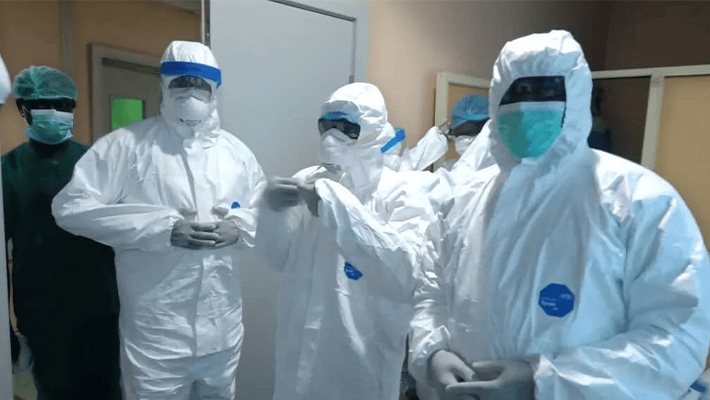
Five steps Nigerians should take to avoid catching Ebola virus
Amid ongoing contact-tracing efforts, Peoples Gazette shares five steps Nigerians can take to prevent contracting Ebola virus.
Health
Ebola: Kano govt activates emergency operations centre
KNCDC has activated a public health emergency operations Centre following the federal government’s announcement of an Ebola case in the Federal Capital Territory.

Abuja
ACCI urges FG to sustain economic policies beyond 2027
ACCI has urged the federal government to sustain economic policies beyond the 2027 elections to support Nigeria’s ambition of building a trillion-dollar economy.

Economy
Tinubu’s Kaduna campaign flag-off drives hotel bookings to capacity
At Bafra Hotel, Yakubu Avenue, Ungwan Rimi, the manager, Christopher Ugbede, said all the hotel’s 149 rooms had been booked ahead of Mr Tinubu’s visit.

Africa
Nigeria, Ghana partner to strengthen fisheries management, blue economy
Nigeria and Ghana have partnered to strengthen fisheries management, protect marine resources and advance a secure, productive and sustainable blue economy in the Gulf of Guinea.
Heading 3
Ten things to know about Nigeria’s latest deadly Ebola virus case
Nigeria on Tuesday reported its first Ebola case in Abuja, the nation’s capital, where a female patient travelling through Uganda began presenting symptoms after arriving in the country.


