

Yobe, Adamawa, Borno unveil flooding emergency response strategies
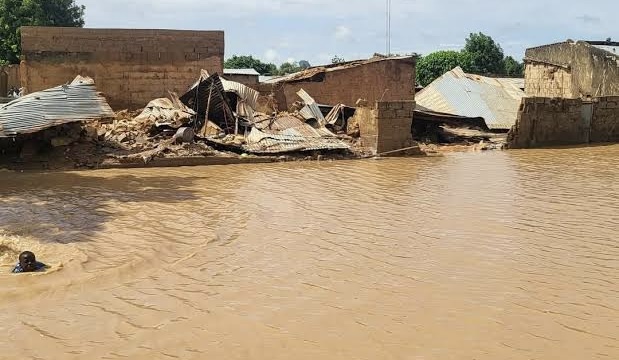
The Yobe, Adamawa, and Borno governments have rolled out various emergency response plans to tackle the impending flooding.
They made this known while responding to questions on the state government’s preparedness to tackle the natural disaster.
The Nigerian Meteorological Agency and the Nigeria Hydrological Services Agency previously predicted floods, wind, storms and prolonged dry spells in some parts of the country.
Ibrahim Jalo, director of search and rescue operations at the Yobe State Emergency Management Agency, said the agency had deployed real-time river-monitoring digital platforms in riverine communities.
Mr Jalo said the agency engaged critical stakeholders, including security agencies, ministries, persons with disabilities groups and humanitarian partners to strengthen disaster response.
The director added that local government areas’ early warning and action committees had also been activated and trained to improve grassroots emergency response.
Mr Jal said the state government had directed the agency to set aside relief materials and food items for 60,000 households.
Mr Jalo added that 7,400 sandbags had also been earmarked for the construction of embankments in vulnerable communities. According to him, relief materials are being positioned in Damaturu, Potiskum and Geidam to ensure quick access during emergencies.
Mr Jalo said the agency mapped out community leaders and emergency contacts to improve communication and reduce response time during disasters.
The director said the agency planned to evacuate residents of 12 flood-prone areas to higher ground.
He said the agency had already identified safe locations for the evacuees in Gujba, Damaturu, Bursari, Geidam, Yunusari, Fika, Potiskum, Jakusko, Bade, Gulani, Karasuwa and Machina.
Mr Jalo appealed to residents to heed early warning information and cooperate with emergency officials during possible evacuations.
The Adamawa government, on the other hand, said it will soon commence demolition of houses built on waterways as part of efforts to mitigate floods.
Syngana Dahdah, permanent secretary at the Ministry of Environment, said that residents whose houses were earlier marked for demolition and compensation must vacate immediately. She said the ministry had forwarded a memo to Governor Ahmadu Fintiri on desilting drains in Yola and reconstruction of drainages along the Shagari and Yolde Pate axis.
Ms Dahdah said the areas experienced severe flooding in 2025 due to blocked drains and poor water flow.
The permanent secretary said the ministry had also concluded arrangements to demolish embankments built on some farms for irrigation purposes. She said that such embankments were built on waterways, thereby triggering floods in some parts of the state.
Meanwhile, the National Emergency Management Agency has just concluded an awareness campaign on disaster preparedness, early warning systems and risk reduction measures in Yola-North and Yola-South local government areas.
Suleiman Yakubu, NEMA zonal director, said that the exercise was part of the ongoing National Preparedness and Response Campaign 2026.
He said the sensitisation, targeting flooding and related hazards common during the rainy season, benefited Makama, Mbamba, Angwan Tarbo, Shagari, Rimawa and Gbonrinji communities.
In Borno, hundreds of residents have been evacuated from the flood-prone community of Dikwa to safer shelters to reduce their exposure to recurring seasonal flooding.
The director-general of the Borno State Emergency Management Agency, Ali Abdullahi, said the intervention formed part of a broader disaster risk reduction strategy aimed at protecting lives and property.
Mr Abdullahi said the agency continued to provide food and other relief materials to residents of the Kala Balge community, which battled with annual floods due to the release of water from Cameroon.
He said the agency conducted a massive drainage clearance in Maiduguri to prevent blockages of waterways.
Mr Abdullahi said major flood-prone areas of Ajilari Cross, Kopa and Bulumkutu-Dala had received targeted interventions, including drainage desilting and construction of improved drainage infrastructure.
“Ajilari Cross, Kopa and Bulumkutu-Dala remain some of the most vulnerable areas during the rainy season. We are currently expanding drainage systems and clearing blocked waterways to reduce the impact of flooding,” he said.
(NAN)

We have recently deactivated our website's comment provider in favour of other channels of distribution and commentary. We encourage you to join the conversation on our stories via our Facebook, Twitter and other social media pages.

More from Peoples Gazette

Agriculture
FG tasks ECOWAS on leveraging financing strategies for agroecology
The federal government has urged stakeholders in the agriculture and finance sectors in the West Africa region to leverage financing strategies to enhance agroecology practices

Politics
Katsina youths pledge to deliver over 2 million votes to Atiku
“Katsina State is Atiku’s political base because it is his second home.”

States
NOA, Bauchi, deepen partnership to strengthen democracy
“Elections are not only about politicians; they are about the future of every community and every citizen,” he said.

Heading 1
Court adjourns NDC’s suit challenging parts of Electoral Act 2026 until June 9
The case could not proceed due to the judge’s absence.

Heading 3
After running Nigeria aground, Tinubu says APC won’t allow opposition take country backward
He said the general election must reflect that Nigeria’s democracy has matured under the APC.

Lagos
Lagos disburses N2.13 billion to 3,301 residents
He said deneficiaries included indigent residents, students, elderly citizens, persons living with disabilities, small business owners and vulnerable households.

Abuja
Cleaner bags 20-year jail term for stabbing boyfriend to death
She was charged with culpable homicide punishable by death.

NationWide
Stakeholders oppose FG’s plan to phase out ‘non-market-relevant’ university courses
They advocated curriculum modernisation rather than phasing out some academic programmes.


