

Nigeria’s oil, gas sector shows recovery in 2025, faces crucial test in 2026: Expert

An energy expert, Wumi Iledare, says Nigeria’s oil and gas sector recorded a measurable rebound in 2025, driven by improved security, relative regulatory stability and renewed operational activity.
Mr Iledare, a professor emeritus of petroleum economics and policy research at the Louisiana State University Center for Energy Studies, USA, said the gains remain fragile and far from transformational.
He stated this on Thursday in Lagos while reviewing sector performance in 2025 and outlining imperatives for 2026.
According to Mr Iledare, the improved security environment and gradual stabilisation under the Petroleum Industry Act (PIA), combined with renewed government focus on operations, helped reverse parts of the sector’s recent decline.
“The direction of travel is positive. However, the temptation to declare a full turnaround should be resisted. Recovery is not the same as transformation,” he said.
He noted that crude oil production improved from recent lows, averaging between 1.6 and 1.7 million barrels per day in 2025, describing the development as a meaningful recovery.
He, however, cautioned that claims of consistently meeting Nigeria’s OPEC+ quota were not fully supported by production and fiscal data.
“Average output remained below benchmark levels, and oil revenue underperformed budget expectations in the first half of 2025.
“The gains were real but uneven and not yet structurally secured,” he said.
Mr Iledare, who is also the executive director of the Emmanuel Egbogah Foundation, acknowledged progress in curbing crude oil theft and vandalism.
He attributed improvements to enhanced surveillance and stronger community–security collaboration.
“Headline claims of a 90 per cent reduction should be treated with caution.
“Theft estimates remain largely administrative and not independently audited. The trend is credible; the precision is not,” he said.
On upstream activity, he observed that while rig counts rebounded, growth figures were exaggerated by comparison with the unusually depressed 2021 base year.
He added that not all counted rigs were fully active, adding that translating rig numbers into sustained production growth would depend on financing availability, evacuation infrastructure and contract stability.
Mr Iledare said output recovery in 2025 was incremental and driven by multiple factors, including initiatives such as Project One Million Barrels and cost-efficiency measures that refocused attention on brownfield and dormant assets.
“Production outcomes cannot be attributed to any single initiative. Petroleum systems respond to a bundle of incentives, risks and constraints — not policy branding,” he said.
He described the downstream sector as the most contested reform space, noting that Nigeria operates an oligopolistic market structure dominated by a few large players.
He said public debate often framed competition as a moral contest between investors and importers, a view he described as misleading.
“From a petroleum economics standpoint, competition is defined by market structure and regulatory neutrality, not by the size of capital deployed.
“Imports do not negate competition unless subsidised or preferentially treated,” he said.
On the Dangote Refinery, Mr Iledare said its strategic importance to Nigeria’s industrial narrative was not in doubt.
“Claims of sustained 85 per cent utilisation, massive import reduction and billions of dollars in foreign-exchange savings should be seen as projections rather than realised outcomes.
“The refinery’s impact remains contingent on feedstock logistics, pricing transparency, market governance and regulatory consistency,” he said.
He explained that proposed upstream divestments by the Nigerian National Petroleum Company Ltd. (NNPCL) reflected deeper structural pressures.
“This includes capital scarcity, rising operational risk and the limits of state participation in high-risk ventures.
“Divestment is not abdication; it is portfolio optimisation. But without strong board oversight, transparency and disciplined reinvestment of proceeds, it risks becoming a fiscal patch rather than a strategic reset,” he said.
In the gas sector, Mr Iledare said progress on reserve growth, reduced flaring and increased domestic supply broadly aligned with regulatory disclosures.
However, he warned that major projects such as the Ajaokuta–Kaduna–Kano (AKK) pipeline and the Nigeria–Morocco gas pipeline remained vulnerable to execution risks and financing timelines.
“Optimism is warranted; complacency is not,” he said.
He identified the disconnect between production recovery and fiscal performance as one of the clearest signals of unfinished reform.
“Higher output did not translate proportionately into public revenue, reflecting price volatility, cost structures and governance leakages,” he said.
He added that attributing Nigeria’s improved GDP growth primarily to oil risked overstating the sector’s current contribution.
Mr Iledare stressed that the overarching lesson of 2025 was that institutions matter more than announcements, calling for stronger regulatory guardrails and empowered boards of directors to ensure credibility and continuity.
He also underscored the need for visible sectoral leadership, noting that Nigeria’s oil and gas industry was too strategic to be managed by fragmented or virtual authority.
“A substantive, accountable minister remains a necessary condition for coherence and sustained impact.
“2025 was a year of recovery and re-anchoring, not full transformation. The gains are real but fragile.
“The imperative for 2026 is consolidation, discipline and institutional endurance,” Mr Iledare said.
(NAN)

We have recently deactivated our website's comment provider in favour of other channels of distribution and commentary. We encourage you to join the conversation on our stories via our Facebook, Twitter and other social media pages.


More from Peoples Gazette

Agriculture
FG tasks ECOWAS on leveraging financing strategies for agroecology
The federal government has urged stakeholders in the agriculture and finance sectors in the West Africa region to leverage financing strategies to enhance agroecology practices

Politics
Katsina youths pledge to deliver over 2 million votes to Atiku
“Katsina State is Atiku’s political base because it is his second home.”

NationWide
Gov. Sani marks 55th birthday with donations to orphans, hospital patients
Cash donations were given to more than 200 patients to help them purchase prescribed drugs and pay for laboratory tests.

Economy
MAN lists conditions for manufacturing rebound in new year
Mr Ajayi-Kadir said the Central Bank of Nigeria (CBN) was anticipated to implement further cuts in the benchmark interest rate to about 23 per cent.

States
Troops foil bandit attack, neutralise five in Plateau
The source said some of the terrorists fled with possible gunshot wounds.

NationWide
Alleged copyright breach in Nollywood Christmas film stirs controversy
The backlash intensified after actor Baaj Adebule said he identified major similarities between both films and questioned the originality of the script.

States
Gunmen invade Kwara community, kidnap monarch, son
A resident told the Peoples Gazette that the suspected terrorists appeared to have targeted the traditional ruler.
NationWide
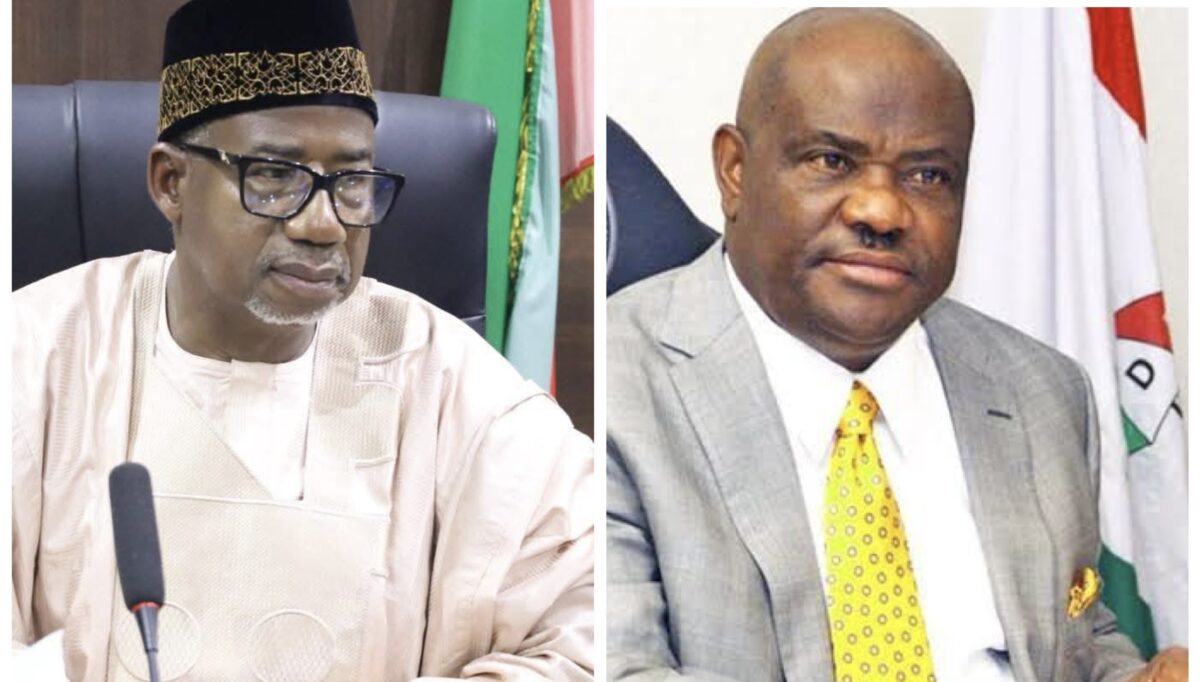
Wike behind EFCC’s prosecution of my finance commissioner for alleged terrorism financing: Bauchi governor
Mr Mohammed labelled Mr Wike a terrorist during the interview.


