
I was wrong to delay telcos’ entry into Nigeria’s financial services: Sanusi

Former Central Bank of Nigeria Governor (CBN), Sanusi Lamido Sanusi, has admitted that he was wrong to have delayed the entry of telecommunications companies into Nigeria’s financial services space.
Mr Sanusi, currently the Emir of Kano, made the statement at the inauguration of the Access to Financial Services in Nigeria (A2F) 2026 Survey Report in Abuja on Wednesday.
He said that the decision made during his tenure as the governor of CBN slowed the expansion of financial inclusion.
Mr Sanusi said his decision was influenced by concerns over the safety of depositors’ funds following the banking crisis at the time.
However, reflecting on his tenure as CBN governor, he said the subsequent growth of fintechs and mobile-based financial services had demonstrated that telcos could have accelerated financial inclusion much earlier.
“I am responsible for delaying the entry of telcos into this space.
“Part of the challenges we had was that we just came out of a banking crisis where we were worried about depositors’ funds.
“I wasn’t comfortable allowing companies that I was not the primary regulator of to have access to a huge pool of funds,” Mr Sanusi said.
He said that with hindsight, the decision showed how policies driven by legitimate concerns could produce unintended consequences.
“I do think if I had allowed that to happen, there wouldn’t have been much more progress,” he said.
Mr Sanusi commended the subsequent CBN administrations for opening the space to telecommunications companies and fintech operators.
According to him, financial inclusion has advanced more rapidly in recent years because digital financial service providers have been able to reach parts of the country that conventional banks struggle to serve.
“I think we have made more progress in the last few years than we did in the first one because the banks simply don’t have the boots on the ground. They don’t have the footprint to do it,” he said.
The emir said that the next phase of financial inclusion should therefore focus not only on increasing the number of people who can access financial services but also on building products around the financial activities Nigerians already undertake every day.
He urged the CBN and other financial regulators to examine the large volumes of transactions passing through fintech and payment platforms and develop mechanisms that can convert a portion of those flows into savings, insurance and pension products.
“If one company is moving $360 billion, which is more than your GDP, you can’t ignore that company,” Mr Sanusi said.
Mr Sanusi suggested that small deductions from everyday transactions could gradually build financial buffers for people who may otherwise struggle to make large, regular contributions to formal savings or insurance schemes.
“You don’t have to come and pay N1,000 or N2,000. A small amount every day can build over time, over transactions, and build up a pool of savings,” he said.
Mr Sanusi also argued that financial inclusion should provide protection against economic shocks, particularly for low-income households, farmers and small businesses.
He cited market fires and poor harvests as examples of events that could wipe out years of savings and investment for traders and farmers who lacked insurance coverage.
“You spend all this money, you build all this inventory, you make a lot of money one day, and at this point, one fire destroys you, one bad crop destroys you,” he said.
He called for closer collaboration among financial regulators, including the CBN, PenCom and the National Insurance Commission, to develop products that combine savings, pensions and insurance while using existing transaction data and digital infrastructure.
Mr Sanusi said the regulatory framework should encourage co-creation rather than having agencies operate independently, arguing that existing financial infrastructure and transaction data could be used to build products tailored to the needs of different groups.
He also stressed the importance of financial literacy, particularly in regions where access to formal financial services remains relatively low.
According to him, the financial inclusion strategy must recognise differences in economic conditions across the country rather than rely on experiences in major commercial centres.
Mr Sanusi said that access to smartphones and digital financial services in urban centres does not necessarily represent conditions in poorer parts of the country.
He said that financial inclusion should ultimately be measured by whether it helps households build savings, access insurance, secure pensions and withstand economic shocks, rather than simply by the volume or number of financial transactions.
The emir said that controlling inflation remains fundamental to this objective because persistent price increases erode the value of savings and weaken households’ ability to build financial security.
“There is no enemy to savings, no enemy to wealth that is bigger than inflation,” he said.
Mr Sanusi urged policymakers to maintain focus on price stability while using the country’s expanding digital financial infrastructure to build products that connect Nigerians to long-term financial security.
He said that the opportunity now lies in using the transaction data and digital platforms already available to create financial products that work around Nigerians’ everyday economic activities.
(NAN)

We have recently deactivated our website's comment provider in favour of other channels of distribution and commentary. We encourage you to join the conversation on our stories via our Facebook, Twitter and other social media pages.

More from Peoples Gazette

Agriculture
FG tasks ECOWAS on leveraging financing strategies for agroecology
The federal government has urged stakeholders in the agriculture and finance sectors in the West Africa region to leverage financing strategies to enhance agroecology practices

Politics
Katsina youths pledge to deliver over 2 million votes to Atiku
“Katsina State is Atiku’s political base because it is his second home.”
Anti-Corruption
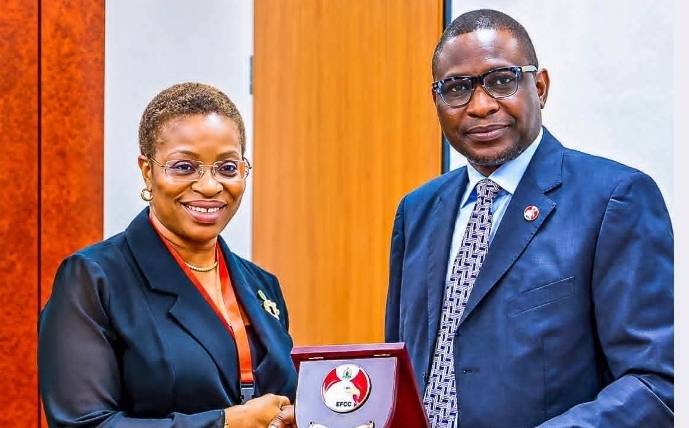
NBA commends EFCC chair over anti-corruption efforts
Mrs Badejo-Okusanya reaffirmed the NBA’s commitment to deepening its partnership with the EFCC.

States
El-Rufai cries out over prolonged detention after 212 days
Mr El-Rufai has remained in detention since February 18.

Anti-Corruption
EFCC nabs MD for alleged N128 million land scam in Enugu
The commission said preliminary investigations showed that the suspect used part of the money to settle his debts.

States
Gunmen kill two vigilantes, injure one in Plateau
On August 18, gunmen invaded Bin-Per community in Kombum district of Mangu council and killed 23 persons.
States
Abacha’s son emerges Kano PDP guber candidate
Mr Gambo-Bichi said the replacement process was conducted in line with the Electoral Act.

NationWide
INEC urges PWDs groups to mobilise members for 2027 polls
Mr Amupitan said participation of PwDs in elections was protected under Section 54 of the Electoral Act 2026.


