

Global economic growth to slow to 3.1% in 2026: World Bank

The International Monetary Fund (IMF) says global growth is projected to slow from 3.3 per cent in 2024 to 3.2 per cent in 2025 and 3.1 per cent in 2026.
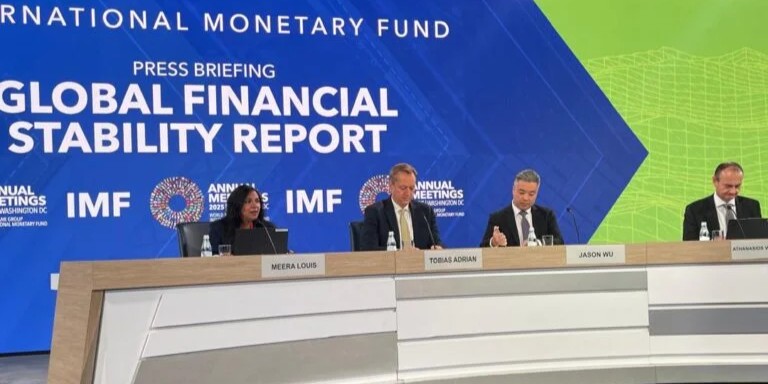
Tobias Adrian, the financial counsellor and director of the Monetary and Capital Markets Department at the IMF, said this on Tuesday in Washington.
Mr Adrian was presenting the World Economic Outlook (WEO) for October on the sidelines of the annual meetings of the World Bank Group.
He said the situation would see advanced economies growing around 1.5 per cent and emerging markets and developing economies just above four per cent.
He projected that inflation will continue to decline globally, though with variation across countries: above target in the U.S., with risks tilted to the upside, and subdued elsewhere.
According to him, the global economy is adjusting to a landscape reshaped by new policy measures.
“Some extremes of higher tariffs were tempered due to subsequent deals and resets, but the overall environment remains volatile, and temporary factors that supported activity in the first half of 2025, such as front-loading, are fading.
“As a result, global growth projections in the latest WEO are revised upward relative to the April WEO but continue to mark a downward revision relative to the pre-policy-shift forecasts,” he said.
He said that risks were tilted to the downside, adding that prolonged uncertainty, more protectionism, and labour supply shocks could reduce growth.
“Fiscal vulnerabilities, potential financial market corrections, and erosion of institutions could threaten stability,” Mr Adrian said.
He urged policymakers to restore confidence through credible, transparent, and sustainable policies.
“Trade diplomacy should be paired with macroeconomic adjustment. Fiscal buffers should be rebuilt. Central bank independence should be preserved. Efforts on structural reforms should be redoubled.
“As shown in the second chapter, past actions to improve policy frameworks have served countries well.
” As chapter three demonstrates, industrial policy may have a role, but full consideration should be given to opportunity costs and trade-offs involved in its use,” he said.
He said that in April, the U.S. shook global trade norms by announcing sweeping tariffs.
”Our April report offered a range of estimates for the resulting growth downgrade, from modest to significant.
“Six months on, where are we? The good news is that the growth downgrade is at the modest end of the range, with growth projected at 3.2 per cent this year and 3.1 per cent next year.
“Inflation has increased modestly and is proving more persistent,” he said.
He said the tariff drop is mainly responsible for the modest impact and is smaller than initially feared, with many trade deals and sanctions.
Mr Adrian said most countries refrained from retaliation, kept the trading system open, and the private sector also declined, contrary to the importance of re-welding supply chains.
”Second, financial conditions remain loose, in part because of a weaker dollar. In some countries, such as Germany and China, fiscal policy turned expansionary, and in the U.S., an AI- and tech-driven investment is booming,” he said.
According to him, despite all these offsets, the tariff drop is weak, further undermining already weak growth prospects.
“This is clear even in the U.S.: growth is revised down from last year, the labour market is weakening, and inflation has been revised up and is persistently above target,” he said.
He said that the outlook remained fragile and very sensitive to news on the trade front.
“I am sure that all of us have noted that flaring up trade tensions with a potential for supply chain disruptions could quickly lower global output by as much as 0.3 percentage points, as we expect in our dynamic economy. Besides trade tensions, I want to quickly flag four other downside risks.
“First, there are echoes in the current tech investment surge of the dot-com boom of the late 1990s. (2:05). It was the internet then; it is AI now. We’re seeing surging valuations, booming investment, and strong consumption on the back of solid capital gains. The risk is that with stronger investment and consumption, a tighter monetary policy would not be needed to contain price pressures.
“This is what happened in the late 1990s. There is also the flip side of it. Markets could reprise sharply. This would reduce wealth, consumption, and investment; lower activity; and increase trade orders and broader financial conditions,” he said.
The World WEO is a survey of prospects and policies by the IMF staff, usually published twice a year, with updates in between.
It presents analyses and projections of the world economy in the near and medium term.
The projections are integral elements of the IMF’s surveillance of economic developments and policies in its member countries and of the global economic system.
(NAN)

We have recently deactivated our website's comment provider in favour of other channels of distribution and commentary. We encourage you to join the conversation on our stories via our Facebook, Twitter and other social media pages.


More from Peoples Gazette

Agriculture
FG tasks ECOWAS on leveraging financing strategies for agroecology
The federal government has urged stakeholders in the agriculture and finance sectors in the West Africa region to leverage financing strategies to enhance agroecology practices

Politics
Katsina youths pledge to deliver over 2 million votes to Atiku
“Katsina State is Atiku’s political base because it is his second home.”

States
Army rescues 9 kidnap victims in Kwara
Mr Okoye said the kidnapped victims were rescued on Monday during a night patrol along Egbe-Okuran in Kogi State and Okoloke through Patigi in Kwara State.

States
Gov Okpebholo inaugurates 19 new commissioners, board chairs
The governor emphasised that his administration had zero tolerance for corruption and expected them to be disciplined and embrace teamwork

States
Ogun assembly passes bill to regulate scavengers, waste dealers’ activities
The bill aims to protect the environment by creating a structured and monitored framework for waste recycling and disposal.
Economy
IMF lauds Tinubu’s economic reforms, says policies yielding positive results
Mr Wu said the steps were in the right direction towards restoring macroeconomic stability and strengthening investor confidence.

Politics
Mbah’s defection from PDP to APC political realignment, not betrayal: Ex-gov
The former governor, during his defection, described the PDP as a “dead party” following a leadership crisis rocking the party.

States
Lagos govt moves to establish cemetery in Surulere, holds consultation with stakeholders
Mr Olumide noted that the proposed cemetery was being considered to meet the pressing need for a burial ground within Surulere, which currently has none.


