

Cardinal Onaiyekan, stakeholders urge religious tolerance, mutual respect in Nigeria
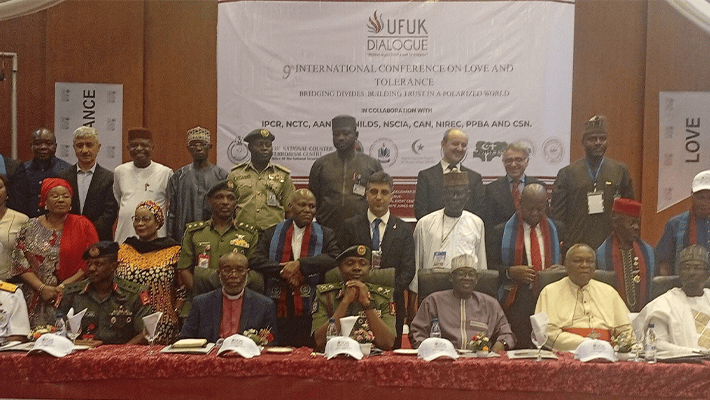
Archbishop Emeritus of Abuja, Cardinal John Onaiyekan, said he once proudly highlighted Nigeria’s religious tolerance and mutual respect to the international community.
According to Mr Onaiyekan, that once beautiful narration has become a “sad anomaly.”
The cleric spoke at the 9th International Conference on “Love and Tolerance,” convened by the Ufuk Dialogue at the Institute for Peace and Conflict Resolution (IPCR) in Abuja on Thursday.
Speaking on the theme, “Bridging Divides – Building Trust in a Polarised World,” the prelate noted that the world was currently witnessing religious organisations and people coming together.
He contrasted this with the situation in Nigeria, observing that while the global trend pointed toward greater religious unity, Nigerians were instead using religion to divide and tear themselves apart.
The cleric stated, “I am 81, and 20 years ago, I thought we were making progress and that we would soon do away with evil people using religion to divide us. Why are we allowing polarisation? People are afraid to talk because they are afraid of offending people.
“Indeed, God created us differently, so let’s celebrate our differences and welcome one another. Nigeria used to be a model of religious tolerance and mutual respect. Twenty years ago, I used to boast about it, but I don’t know what has happened.”
The co-founder of the Interfaith Initiatives for Peace (IIP), said Christians and Muslims should embrace their differences and build bridges so they could jointly confront the nation’s common enemies.
According to the octogenarian, both Christianity and Islam are monotheistic religions, adding that “If either a Christian or a Muslim believes their Gods are different, it implies the existence of at least two Gods—something neither faith teaches.
“If we can work on honesty in every sphere of our national life, we can make progress. Let us agree that we have differences; only then can we work together for the development of our country,” he said.
The Director-General of the IPCR, Dr Joseph Ochogwu, said the conference was taking place at a time when polarisation had become increasingly evident in the country.
He noted that mistrust between communities was rising, state–citizen relations were becoming strained, interface misconceptions were deepening, generational disconnects were growing, and disparities between identities and regions were widening.
He stated, “We also see how misinformation travels faster than truth, reinforcing suspicion and undermining solidarity. The consequences of this fragmentation are severe: increased violent conflicts, political tensions, declining social cohesion, weakened institutions, and diminishing public confidence. Yet, polarisation is not destiny, and mistrust, though deep, remains reversible. “
Represented by Dr Emmanuel Mamman, a director at the institute, Mr Ochogwu said that women, youths, and traditional and religious institutions must play a central role in bridging divides and rebuilding trust.
He said, “Trust cannot be legislated; it is cultivated through those who hold moral influence and generational reach. Women have long been silent architects of unity because they mediate family and community disputes by detecting early signs of tension and spearhead recovery efforts after crises.
“The youths also represent enormous potential because of their technological skills, cultural connection, and global awareness. Yet, many feel excluded from national discourse.
“Rebuilding trust requires meaningful engagement of young people as co-creators of solutions. Not passive recipients.”
Mr Ochogwu said sustainable peace could not be achieved by the government alone.
He called for multi-level partnerships involving civil society, academia, international organisations, media, youth and women groups, including traditional and religious institutions.
He said the task of building trust in a polarised society was daunting but not insurmountable.
In his welcome address, the President of Ufuk Dialogue, Emrah Ilgen, said the annual conference was conceived to promote dialogue, culture of coexistence, mutual understanding, and to establish a common platform for promoting peace.
He said peace was a prerequisite for growth and development, adding that any society that failed to invest in peace could not progress.
First convened in 2013 in Abuja, Mr Ilgen said this year, the Ufuk Dialogue annual conference would, for the first time, also be held in Lagos and Jos.
He attributed the successes of the conference to meaningful collaboration with other peace-building institutions and organisations, both in the public and private sectors.
Goodwill messages were delivered at the event by representatives of the Sultan of Sokoto, Muhammad Sa’ad Abubakar III; the Christian Association of Nigeria; the National Counter-Terrorism Centre, and the Armed Forces.
The President of the National Council of Women’s Societies , Edna Azura, also delivered an address calling on participants to help advance the rights of women and children.
(NAN)

We have recently deactivated our website's comment provider in favour of other channels of distribution and commentary. We encourage you to join the conversation on our stories via our Facebook, Twitter and other social media pages.


More from Peoples Gazette

Agriculture
FG tasks ECOWAS on leveraging financing strategies for agroecology
The federal government has urged stakeholders in the agriculture and finance sectors in the West Africa region to leverage financing strategies to enhance agroecology practices

Politics
Katsina youths pledge to deliver over 2 million votes to Atiku
“Katsina State is Atiku’s political base because it is his second home.”

NationWide
Insecurity: PDP demands full security powers for governors
The chairman reiterated the need to restructure the nation’s security framework.

NationWide
TTP calls for end to number plate fraud in ports, seeks regulation
According to him, the lack of strict control had enabled drivers to clone plate numbers.

NationWide
Respect culture of host communities, NYSC DG tells corps members
He urged corps members to respect the rules and regulations guiding the NYSC scheme.

States
Bandit commanders have relocated to Kogi to attack residents, Gov Ododo raises alarm
Mr Ododo, while assuring residents of their safety, said his administration would not negotiate with criminals or pay ransom under any circumstances.

Education
Court orders FG, states to provide free, compulsory education for Nigerian children
The court adopted a liberal approach to public interest litigation, noting that citizens and groups may challenge violations affecting broad societal interests.

Port Harcourt
INEC seeks stakeholders’ collaboration to boost voter registration in Rivers
According to him, every citizen has a role to play in protecting the electoral process.


